


Table of Contents
- Establishing Your Residential Status under Section 6
- Property Acquisition Mechanics & FEMA Regulations
- Capital Gains Taxation Framework
- Neutralizing the Upfront TDS Trap: Form 13 & Section 197 Blueprint
- Capital Gains Rollover & Statutory Tax Exemptions
- Rental Income & Post-Tax Yield Optimization
- Repatriation Protocol: Moving Sale Proceeds Abroad ($1 Million Rule)
- Special Scenarios: Inheritance, Gifting, and Joint Holdings
- Common Mistakes NRIs Should Avoid
- The Vilāsa Model: De-risking Luxury Real Estate Ownership
- Frequently Asked Questions
Indian luxury real estate has evolved from an emotional connection with one’s heritage into a high-yielding, institutional-grade global asset class. Non-Resident Indians (NRIs) and Overseas Citizens of India (OCIs) investing in prime micro-markets—such as Goa, Alibaug, Coonoor, and Rishikesh—benefit from significant capital appreciation and resilient rental yields. However, navigating the intersection of the Indian Income Tax Act, 1961, and the Foreign Exchange Management Act (FEMA), 1999, requires proactive tax structuring.
Understanding residential status, capital gains tax rules, statutory exemptions, upfront Tax Deducted at Source (TDS) mechanisms, and international repatriation limits is essential for maximizing net internal rate of return (IRR) on Indian real estate investments.
Establishing Your Residential Status under Section 6
Tax liability in India is governed entirely by physical presence during a financial year (April 1 to March 31). This is irrespective of citizenship or foreign passport status.

Statutory Classifications
- Non-Resident Indian (NRI): An individual who stays in India for fewer than 182 days during a financial year. NRIs are taxed solely on income generated, accrued, or received within India.
- Resident and Ordinarily Resident (ROR): An individual residing in India for 182 days or more (or 60 days in the relevant year plus 365 days across the preceding 4 years). RORs are subject to tax on their worldwide global income.
- Resident but Not Ordinarily Resident (RNOR): A transitional status for returning NRIs who meet resident conditions but have been non-residents in 9 out of the 10 preceding financial years. Foreign income remains exempt unless derived from a business controlled or set up in India.
- Deemed Resident (Section 6(1A)): Introduced under the Finance Act, an Indian citizen earning total income from Indian sources exceeding ₹15 Lakhs during a financial year will be classified as a Deemed Resident (RNOR) if they are not liable to pay tax in any other country or jurisdiction by reason of domicile or residence (e.g., UAE residents).
| Residential Status Classification | Physical Days in Current FY | Indian Real Estate Income Taxable? | Global Foreign Income Taxable in India? |
| Non-Resident Indian (NRI) | < 182 days | Yes (Source Country Rule) | No |
| Resident but Not Ordinarily Resident (RNOR) | ≥ 182 days (NR in 9/10 prior years) | Yes | No (unless controlled from India) |
| Resident & Ordinarily Resident (ROR) | ≥ 182 days | Yes | Yes (Worldwide scope) |
Property Acquisition Mechanics & FEMA Regulations
FEMA regulations govern the acquisition, holding, and transfer of immovable property in India by overseas residents.

Permissible vs. Prohibited Assets
- Permitted: NRIs and OCIs can purchase residential and commercial properties in India without prior approval from the Reserve Bank of India (RBI). There is no restriction on the number of residential or commercial units an NRI can acquire.
- Prohibited: NRIs and OCIs are strictly prohibited from purchasing agricultural land, plantation property, or farmhouses. Such properties can only be acquired through inheritance or gifts approved by the RBI.
Authorized Payment Channels
Transactions must strictly route through formal banking channels:
- NRE Account (Non-Resident External): Funded by foreign currency earnings; fully repatriable.
- NRO Account (Non-Resident Ordinary): Funded by Indian-sourced income (rent, dividends); subject to repatriation limits.
- FCNR(B) Account (Foreign Currency Non-Resident): Foreign currency fixed deposits converted directly at settlement.
- Prohibited Payment Modes: Payments made via cash, traveler’s cheques, or foreign currency notes are illegal under FEMA rules.
Capital Gains Taxation Framework
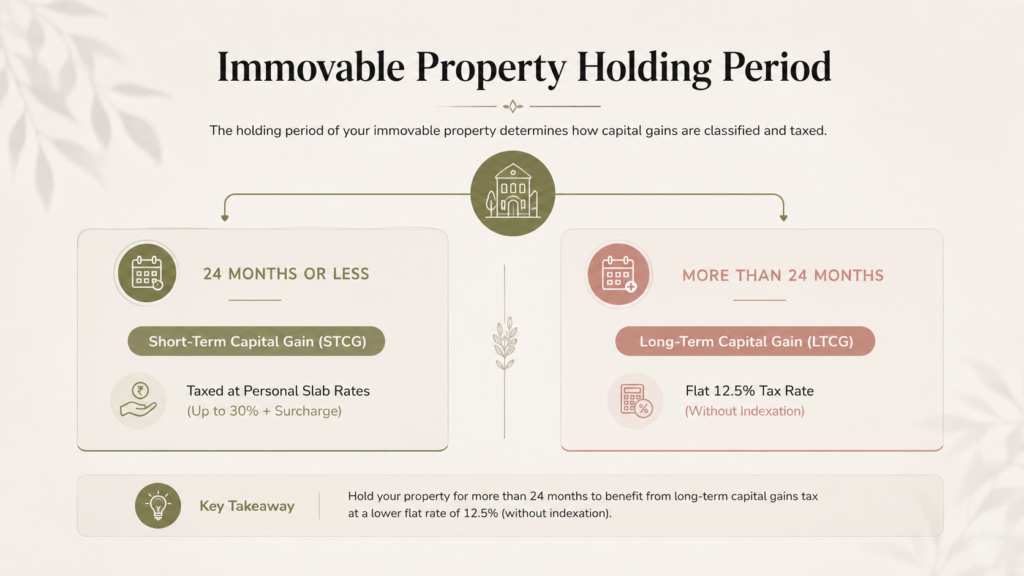
Capital gains on property transactions executed by NRIs depend on the holding period. Properties held for up to 24 months generate Short-Term Capital Gains (STCG). However, properties held for more than 24 months qualify for Long-Term Capital Gains (LTCG).
Short-Term Capital Gains (STCG)
- Holding Period: ≤ 24 months.
- Taxation Rate: Added to the NRI’s taxable Indian income and taxed at the applicable personal income tax slab rate (up to 30% plus applicable surcharge and 4% Health & Education Cess).
Long-Term Capital Gains (LTCG)
- Holding Period: > 24 months.
- Taxation Rate: 12.5% flat rate without indexation.
- NRI Indexation Restriction: While resident taxpayers were offered a grandfathering option (choosing between 12.5% without indexation and 20% with indexation) for properties acquired before July 23, 2024, NRIs are ineligible for the 20% indexation option. All NRI long-term real estate transfers are assessed at a flat 12.5% rate without indexation adjustments.
Capital Gains Calculation Formula
For an NRI selling property held for over 24 months:
Neutralizing the Upfront TDS Trap: Form 13 & Section 197 Blueprint
The primary cash-flow risk for an NRI selling Indian real estate stems from Section 195 withholding provisions.
The Problem: Consideration-Based Withholding
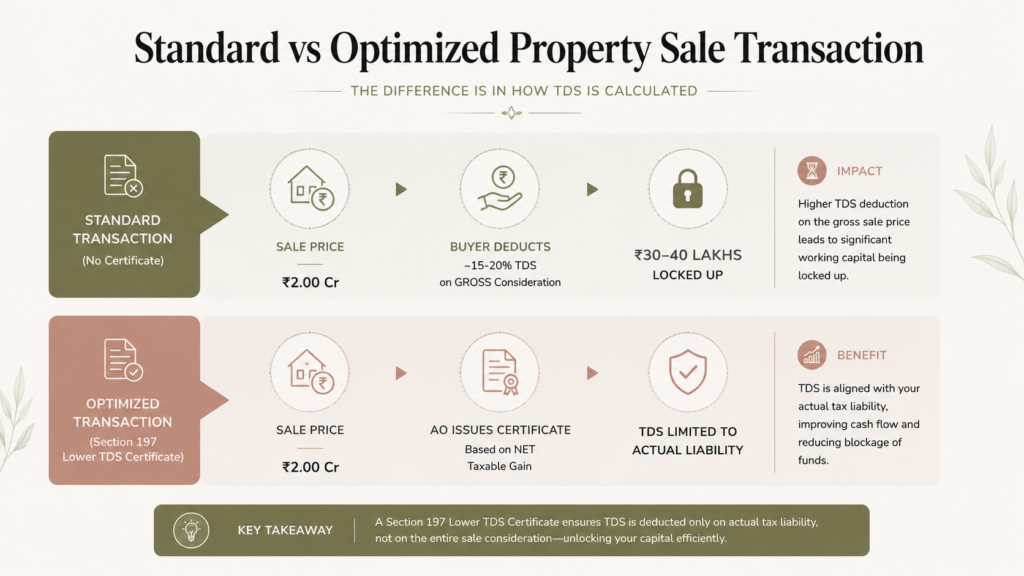
When purchasing property from an NRI, the buyer is required by law to deduct TDS on the total gross sale consideration, not on the net capital gain.
Without a tax certificate, the buyer must deduct TDS at 12.5% (for LTCG) or 30% (for STCG), plus applicable surcharges (which can reach 15%–25%) and 4% cess. This can result in an upfront tax deduction of 15% to 20%+ on the total sale price, locking up liquid funds for 12 to 18 months until an Indian Income Tax Return (ITR) is processed.
The Solution: Lower TDS Certificate (Form 13 / Section 197)
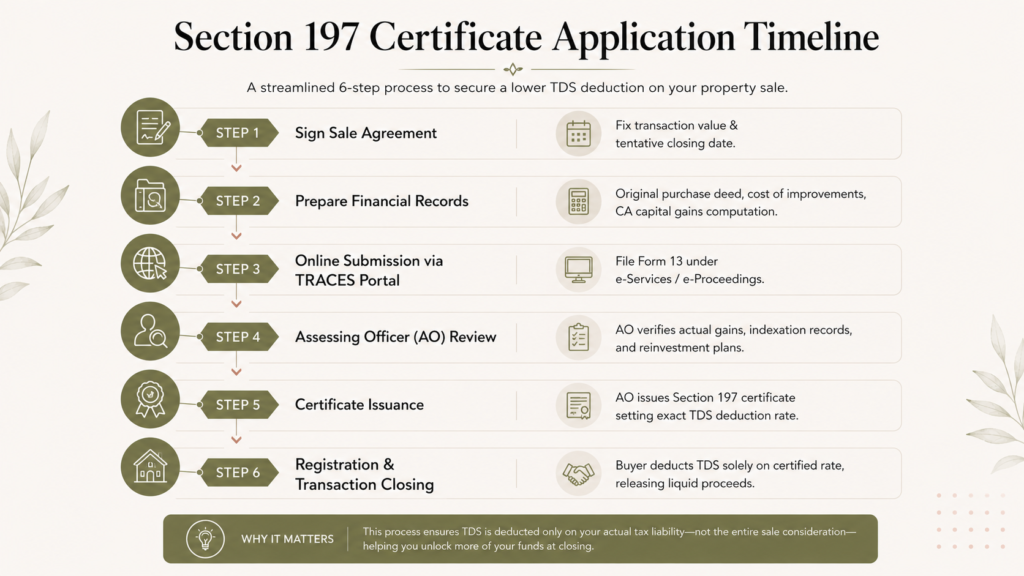
NRIs can prevent excess capital withholding by obtaining a Lower Deduction Certificate under Section 197 of the Income Tax Act prior to executing the final sale deed.
Required Documentation for Form 13
- PAN Card of the NRI seller.
- Executed Agreement to Sell or Memorandum of Understanding (MoU).
- Original Acquisition Deed establishing title and historical cost.
- Proof of Improvements (invoices, municipal approvals, architect receipts).
- CA Capital Gains Statement showing computation of taxable profits.
- Income Tax Returns (ITR) of the seller for the last 3 financial years.
- NRE/NRO Bank Statements proving payment sourcing.
Capital Gains Rollover & Statutory Tax Exemptions
NRIs can legally reduce their long-term capital gains tax liability to zero. This is done by utilizing statutory rollover provisions under Sections 54, 54EC, and 54F.

Section 54: Residential Property Reinvestment
- Eligibility: Long-Term Capital Gains derived from selling a residential property.
- Condition: Reinvest the net capital gain into one residential property located in India.
- Special Provision: If the LTCG is less than or equal to ₹2 Crores, the NRI can reinvest in two residential properties in India (available once in a lifetime).
- Timelines: Purchase 1 year before or 2 years after the sale date, or complete construction within 3 years.
- Capping: Reinvestment deduction capped at a maximum of ₹10 Crores.
Section 54EC: Capital Gain Infrastructure Bonds
- Eligibility: LTCG derived from real estate sales.
- Condition: Invest capital gains into specified infrastructure bonds issued by National Highways Authority of India (NHAI), Rural Electrification Corporation (REC), Power Finance Corporation (PFC), or Indian Railway Finance Corporation (IRFC).
- Investment Limit: Capped at ₹50 Lakhs per financial year.
- Timeline: Must be invested within 6 months of the sale date.
- Lock-in Period: 5 years (interest earned is taxable).
Section 54F: Reinvestment from Non-Residential Assets
- Eligibility: Long-Term Capital Gains derived from selling any non-residential capital asset (e.g., commercial property, unlisted shares, gold).
- Condition: The NRI must reinvest the entire net sale consideration (not just the gain) into purchasing or constructing one residential property in India.
- Restriction: The seller must not own more than one other residential house on the date of sale.
Capital Gains Account Scheme (CGAS), 1988
If the reinvestment under Section 54 or 54F is not completed before the due date for filing the Indian Income Tax Return (July 31 following the financial year), the unutilized gains must be deposited into a Capital Gains Account Scheme (CGAS) with an authorized public bank to maintain exemption status.
Rental Income & Post-Tax Yield Optimization
Earning rental yields on Indian properties provides passive local income, but understanding taxable deductions under Section 24 maximizes post-tax net yield.
Net Taxable Rent Calculation
- Standard Deduction (Section 24a): A flat 30% deduction on the NAV is automatically applied for maintenance and repairs, regardless of actual expenses incurred.
- Home Loan Interest Deduction (Section 24b): Interest paid on loans used to acquire, construct, or repair property in India can be deducted against rental income:
- Self-Occupied Property: Capped at ₹2 Lakhs per annum.
- Let-Out Property: Full actual interest paid is deductible without an upper limit (though aggregate loss set-off against other income heads is restricted to ₹2 Lakhs per year).
Tenant Withholding Obligation (Section 195)
Tenants renting a property from an NRI landlord are legally obligated to deduct 31.2% TDS (30% tax + 4% cess) before transferring the monthly rent to the NRI’s account, filing Form 27Q quarterly. NRIs can provide a Section 197 Lower TDS Certificate to their tenants. This reduces the rate based on actual net taxable rent.
Double Taxation Avoidance Agreements (DTAA)
To prevent paying tax twice—in India and in their foreign country of residence—NRIs leverage bilateral DTAA provisions.
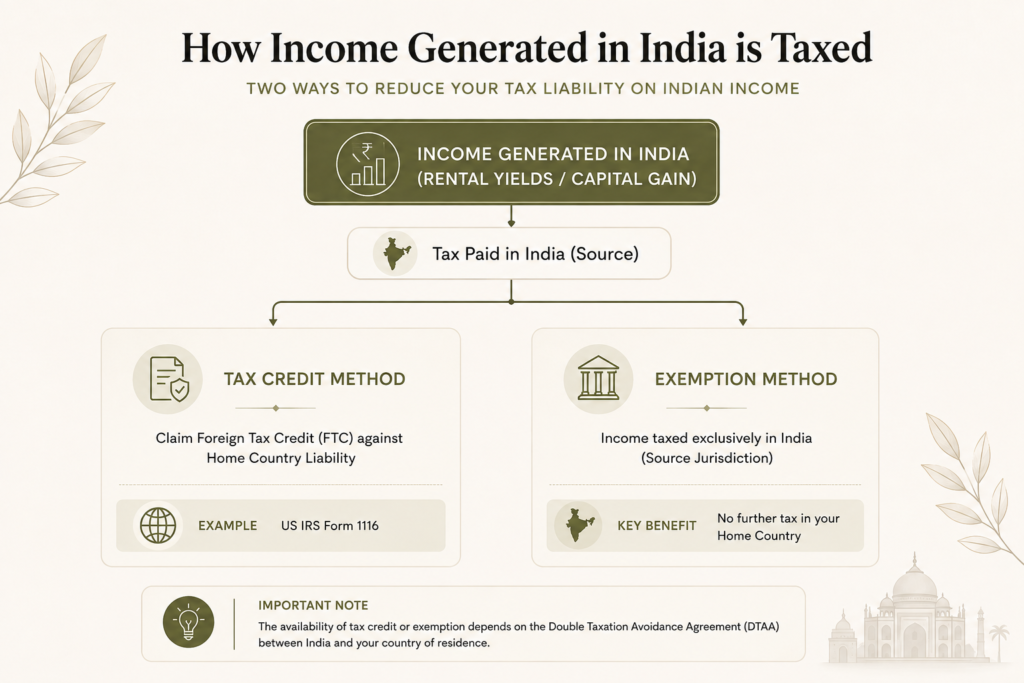
- USA (Article 6 – Real Property): Rental income and capital gains from Indian real estate are taxable in India. US tax residents report this income on IRS Form 1040 and claim a Foreign Tax Credit (FTC) on IRS Form 1116 for taxes paid in India.
- UK: UK tax residents report Indian rental profits to HMRC on the Foreign pages of Form SA106, claiming Foreign Tax Credit Relief (FTCR) against UK tax liabilities.
- UAE: As the UAE levies no personal income tax on real estate returns, income from Indian property is taxed solely in India without secondary liabilities.
Repatriation Protocol: Moving Sale Proceeds Abroad ($1 Million Rule)
Under the Foreign Exchange Management (Remittance of Assets) Regulations, NRIs can repatriate sale proceeds and rental income overseas.
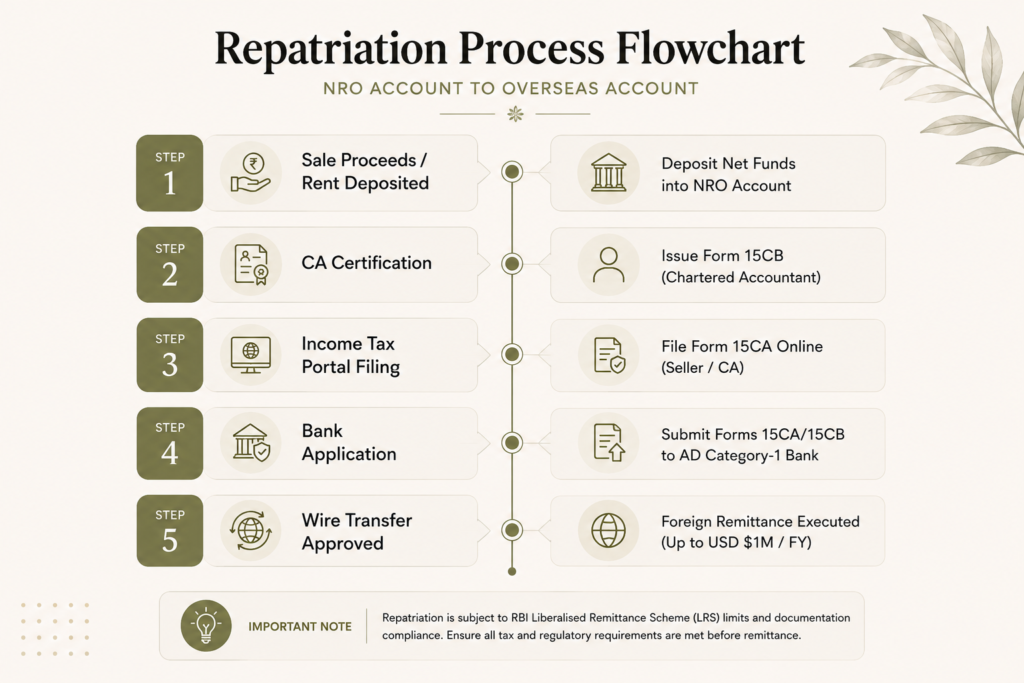
Key Repatriation Rules
- NRO Account Limit: Remittance of funds held in an NRO account (derived from property sales or local income) is capped at USD $1 Million per financial year.
- NRE Account Unlimited Repatriation: If the original property purchase was funded strictly via inward foreign remittances or through an NRE account, the principal amount (up to the original foreign currency input) can be repatriated through the NRE account without triggering the USD $1 Million NRO cap.
- Mandatory Documentation:
- Form 15CB: Certificate issued by a practicing Chartered Accountant confirming that appropriate taxes have been paid in India.
- Form 15CA: An online declaration filed on the Income Tax e-filing portal certifying tax clearance.
Special Scenarios: Inheritance, Gifting, and Joint Holdings
Inherited Property
- Holding Period Continuity: When an NRI inherits property in India, the holding period includes the time the property was held by the deceased owner.
- Cost Base: The cost of acquisition is deemed to be the cost paid by the original purchaser who bought the property through an arm’s length transaction.
Gifting Property (Section 56(2)(x))
- Tax-Free Transfer: Gifting real estate between defined “relatives” (lineal ascendants, descendants, spouse, siblings) is completely exempt from gift tax in India under Section 56(2)(x).
- Stamp Duty Applies: While income tax is exempt on gifts, state stamp duty and registration fees remain payable upon deed execution.
- Subsequent Sale: If the NRI sell a gifted property, capital gains are computed using the original acquisition cost and holding period of the donor.
Joint Holdings
- Dual Exemption Caps: Holding property jointly with an NRI spouse or relative allows both owners to claim independent tax exemptions under Section 54 (up to ₹10 Crores each) and Section 54EC (up to ₹50 Lakhs each), provided both co-owners contributed to the acquisition cost.
Common Mistakes NRIs Should Avoid
- Miscalculating the 182-Day Status Threshold: Relying on calendar years rather than Indian financial years (April 1 to March 31) can unexpectedly result in ROR status and global tax exposure.
- Purchasing Agricultural Land or Farmhouses: Attempting to buy agricultural plots or non-converted farmhouses violates FEMA regulations, risking RBI confiscation penalties.
- Overpaying Upfront TDS at Closing: Failing to apply for a Section 197 Lower TDS Certificate (Form 13) prior to registration leads to 12.5%–20%+ of the gross sale price being withheld for over a year.
- Mixing NRE and NRO Accounts: Deposit of domestic income (e.g., local rent or Indian rupee funds) into an NRE account violates FEMA regulations; domestic revenue must route strictly through NRO accounts.
- Missing the 6-Month Section 54EC Deadline: Delaying investment in infrastructure bonds beyond 6 months from the sale date invalidates the capital gains exemption.
The Vilāsa Model: De-risking Luxury Real Estate Ownership
Investing in luxury real estate from overseas requires a seamless operational model. Vilāsa designs, constructs, and manages private estates in India’s top leisure destinations, including Goa and Kasauli.

By providing turnkey legal verification, automated rental administration, municipal tax compliance, and bespoke estate maintenance, Vilāsa eliminates the operational complexity of managing Indian real estate assets from abroad.
Frequently Asked Questions
For property transfers, Long-Term Capital Gains (LTCG) for NRIs are taxed at a flat rate of 12.5% without indexation, provided the property was held for more than 24 months. Applicable surcharges and a 4% Health & Education Cess are added to this baseline rate.
No. While resident taxpayers were offered a grandfathering choice (20% with indexation or 12.5% without indexation) for real estate acquired before July 23, 2024, NRIs are ineligible for the indexation option. All NRI long-term capital gains on property are assessed at 12.5% without indexation.
An NRI seller can apply for a Lower Deduction Certificate under Section 197 (Form 13) on the Income Tax TRACES portal before property registration. The Assessing Officer evaluates the seller’s actual capital gains liability and issues a certificate instructing the buyer to deduct TDS at a reduced rate based on net profit rather than gross consideration.
No. Under FEMA regulations, NRIs and OCIs are strictly prohibited from purchasing agricultural land, plantation property, or farmhouses in India. These properties can only be acquired through inheritance or gifts approved by the RBI.
An NRI can repatriate up to USD $1 Million per financial year from funds held in an NRO account, subject to tax compliance and submission of Form 15CA and Form 15CB (certified by a Chartered Accountant). Funds originally sourced directly from foreign inward remittances or NRE accounts face no annual repatriation limits.