


Table of Contents
- Key Takeaways & Fast-Facts
- What Is RERA & Why Was It Enacted?
- The RERA Carpet Area Formula: Demystifying the Math
- RERA vs. Non-RERA Properties: Direct Comparison
- Core Legal Protections Every Homebuyer Must Know
- Step-by-Step: How to Verify Any Project on the RERA Portal
- The NRI Homebuyer’s RERA & Legal Playbook
- Common RERA Myths vs. Ground Realities
- The 10-Point Pre-Purchase RERA Verification Checklist
- Frequently Asked Questions
Key Takeaways & Fast-Facts
- 70% Escrow Protection: Developers must deposit 70% of all funds collected from buyers into a dedicated project escrow account usable only for land and construction costs.
- Standardized Carpet Area: Property pricing is legally mandated based on RERA Carpet Area, eliminating artificial inflation from “super built-up” calculations.
- 5-Year Structural Defect Warranty: Developers are legally required to repair structural defects or workmanship flaws within 5 years of possession at zero cost to the buyer.
- Enforceable Delay Penalties: If a project misses its promised possession date, buyers can claim monthly interest equal to SBI’s highest MCLR + 2% or opt for a full refund with interest.
- Symmetric Default Rates: The interest rate developers pay for project delays is identical to the interest rate buyers pay if they default on installment payments.
What Is RERA & Why Was It Enacted?
The Real Estate (Regulation and Development) Act, 2016 (RERA) is India’s landmark federal legislation designed to regulate the real estate sector, mandate financial discipline, and establish a transparent marketplace for property buyers.
Before RERA came into force in May 2017, real estate transactions heavily favored developers. Homebuyers routinely faced:
- Indefinite project delays with no financial recourse.
- Fund siphoning, where developers diverted pre-sales capital from one project to finance land acquisitions elsewhere.
- Misleading area measurements where “super built-up area” inflated prices by including common stairwells, elevator shafts, and lobbies.
RERA transformed this landscape by creating dedicated state-level regulatory authorities (such as Goa RERA, MahaRERA, and UP RERA) and establishing a legally enforceable framework that protects buyers’ capital from pre-construction marketing to post-handover maintenance.
The RERA Carpet Area Formula: Demystifying the Math
One of RERA’s biggest structural wins for homebuyers is standardizing how property size is measured and billed. Prior to RERA, developers sold units on a “super built-up area” basis—a metric that could inflate the billable area by 30% to 50% above the actual living space.
Under Section 2(k) of the RERA Act, developers must price properties strictly according to RERA Carpet Area.
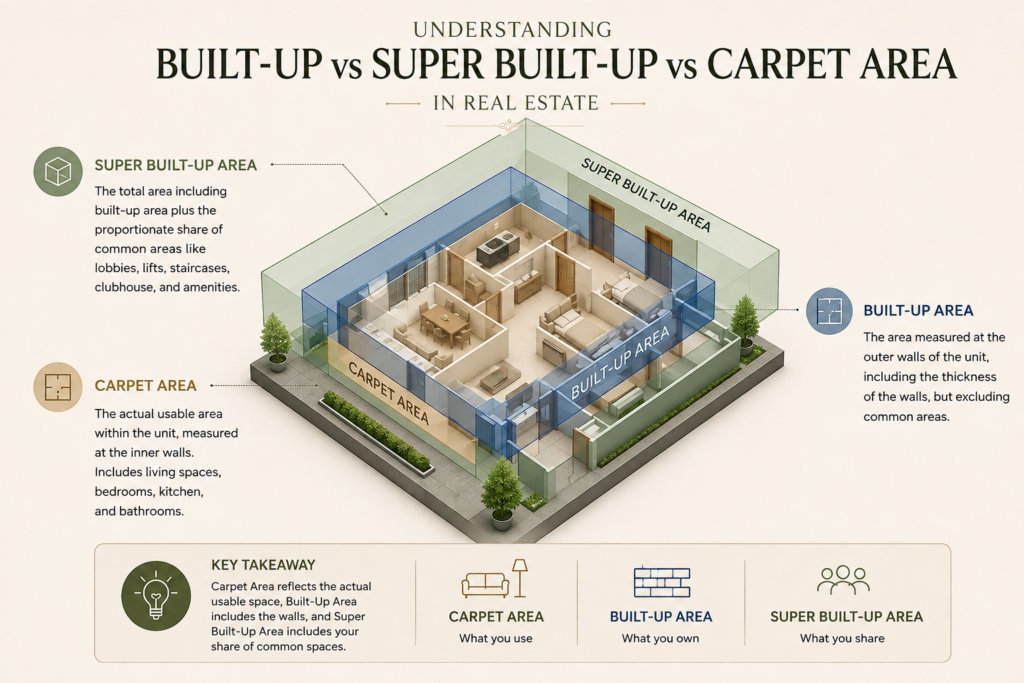
Mathematical Formula
Area Measurement Breakdown
| Area Classification | Included in RERA Carpet Area? | Explanation |
| Living Room, Bedrooms, Kitchen | YES | Usable internal floor space where carpets can be laid. |
| Bathrooms & Internal Storage | YES | All internal usable floor space within the unit boundary. |
| Internal Partition Walls | YES | Thickness of walls separating rooms inside the apartment/villa. |
| Balconies & Verandahs | NO | Must be billed separately as a distinct line item if sold. |
| External Boundary Walls | NO | Outer load-bearing wall perimeter is excluded. |
| Lobbies, Elevators, Staircases | NO | Common areas cannot be added into individual unit carpet area. |
Pro Tip for Buyers: When reviewing a developer’s agreement for sale, always check the ratio of RERA Carpet Area to Built-Up Area. In premium developments, transparency in carpet area calculations ensures you pay strictly for internal living space.
RERA vs. Non-RERA Properties: Direct Comparison
Understanding the structural risk gap between registered and non-registered properties is vital before making a real estate investment.
| Regulatory Feature | RERA-Registered Property | Non-RERA Property |
| Capital Security | 70% of collections locked in project-specific escrow. | Unregulated; builder can divert funds freely. |
| Sales Metric | Mandatory pricing by RERA Carpet Area. | Often billed on inflated Super Built-Up metrics. |
| Delay Remedies | SBI MCLR + 2% interest penalty or full refund. | Requires prolonged civil litigation without standard rates. |
| Defect Liability | Mandatory 5-year structural warranty at builder cost. | No statutory defect liability period. |
| Dispute Resolution | Specialized RERA Tribunal (Statutory 60-day target). | Civil courts (can take 5–10 years to reach judgment). |
| Public Transparency | Public disclosures of title, plans, and quarterly progress. | No public oversight; plans can be altered unannounced. |
Core Legal Protections Every Homebuyer Must Know
A. The 70% Escrow Fund Lock-in
To eliminate insolvency caused by fund diversion, Section 4(2)(l)(D) mandates that developers deposit 70% of all payments collected from buyers into a separate bank account (escrow account) maintained with a scheduled bank.
- Withdrawal Restrictions: Funds can only be withdrawn in proportion to the percentage of project completion.
- Audit Trail: Withdrawals require certification from an engineer, an architect, and a practicing chartered accountant.
B. 5-Year Structural Defect Warranty
Under Section 14(3), if any structural defect or defect in workmanship, quality, or provision of services is brought to the notice of the promoter within 5 years from the date of handing over possession:
- The developer is legally obligated to rectify the defect at no extra cost within 30 days.
- If the developer fails to rectify the defect, the buyer is entitled to receive financial compensation under the Act.
C. Delay Compensation Math: SBI MCLR + 2%
Under Section 18 of RERA, if a developer fails to hand over possession by the date committed in the agreement for sale, the buyer has two statutory choices:
- Withdraw from the project: Claim a full refund of all amounts paid, along with interest calculated from the date of payment.
- Remain in the project: Receive monthly interest compensation for every month of delay until possession is delivered.
Calculating the Interest Rate
RERA rules mandate that the compensation interest rate is floating and tied to the State Bank of India (SBI) Highest Marginal Cost of Lending Rate (MCLR) + 2% per annum.
Calculation Example
- Total Amount Paid: ₹2,00,00,000 (₹2 Crore)
- Promised Possession Date: January 1, 2025
- Actual Handover Date: January 1, 2026 (12 months delay)
- Applicable SBI MCLR Rate: 8.80%
Step-by-Step: How to Verify Any Project on the RERA Portal
Before transferring a token amount or signing a booking form, independently verify the development on the relevant state RERA portal.
1. Locate the Official State RERA Authority Portal:Always verify you are on an official gov.in domain.
Access the official state portal (e.g., rera.goa.gov.in for Goa). Avoid third-party aggregator sites.
2. Search Registered Projects: Locate the public verification database.
Navigate to the ‘Services’ or ‘View Registration’ tab and select ‘Registered Projects’. Enter either the unique RERA Registration Number provided by the developer or the exact Project Name.
3. Inspect the Land Title & Encumbrance Status: Verify ownership integrity.
Open the project details page and download the Title Search Report and Encumbrance Certificate. Confirm that the land owner name matches the developer or that a legal Joint Development Agreement (JDA) is registered.
4. Review Approved Building Plans & Sanctions: Ensure layout compliance.
Cross-examine the floor plans shown to you in the sales office against the Sanctioned Plans uploaded to the RERA portal. Check for any unauthorized floors or unapproved structural variations.
5. Audit Quarterly Progress Reports (QPRs): Track construction velocity.
Examine the developer’s latest QPR filings. Review the physical percentage of completion, financial statements, and whether the targeted completion date has been revised.
The NRI Homebuyer’s RERA & Legal Playbook
For Non-Resident Indians (NRIs) buying luxury holiday homes or investment properties in India, RERA offers significant legal safeguards when combined with Foreign Exchange Management Act (FEMA) guidelines.
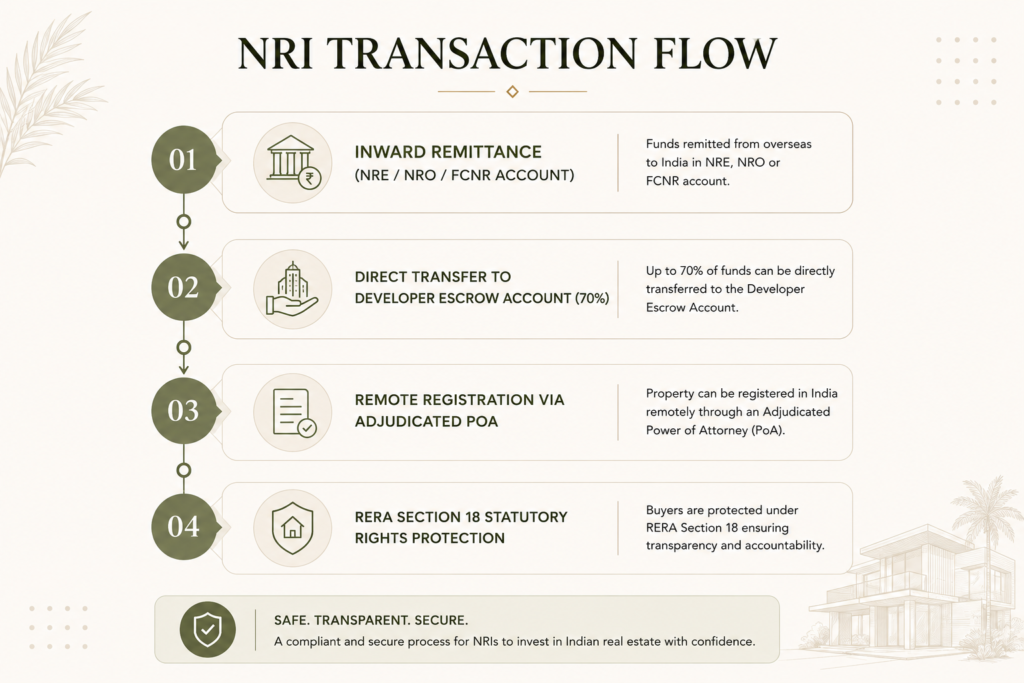
Key Considerations for NRIs
- Escrow Funding Compliance: Payments must originate from an NRE/NRO account or via direct foreign inward remittance through normal banking channels. Funds must be routed directly into the project’s designated RERA escrow account.
- Power of Attorney (PoA) Execution: If you cannot be physically present in India to sign the RERA Agreement for Sale, execute a PoA. The PoA must be executed before an official notary or Indian Consulate/Embassy in your country of residence and subsequently adjudicated by the local District Collector in India within 3 months of receipt.
- Tax Deducted at Source (TDS): When an NRI purchases property from a resident developer, standard payment schedules apply. However, if an NRI sells property, the buyer must deduct TDS under Section 195 of the Income Tax Act.
Common RERA Myths vs. Ground Realities
Myth 1: “RERA registration guarantees zero financial or project risk.”
- Ground Reality: RERA registration verifies legal approvals, land titles, and financial compliance at registration. Buyers must still perform due diligence on developer credibility, construction quality, and project execution track record.
Myth 2: “RERA only applies to under-construction properties.”
- Ground Reality: RERA applies to all ongoing and new developments exceeding 500 square meters or 8 apartments. Furthermore, the 5-year structural defect warranty applies post-possession, protecting buyers of completed units.
Myth 3: “A developer can unilaterally extend the completion date.”
- Ground Reality: Developers can only request a project extension due to force majeure (unforeseen disasters) or exceptional circumstances approved by the RERA Authority, usually capped at a maximum of 1 year. Unilateral changes are prohibited.
The 10-Point Pre-Purchase RERA Verification Checklist
Before issuing any payment, ensure the following 10 items are verified:
- RERA Registration Number: Is the project registered on the official state portal?
- Promoter Profile: Does the promoter’s registered name match the sales contract?
- Title Search Certificate: Is the land free from litigation and encumbrances?
- Sanctioned Layout Plan: Does the unit floor plan match the RERA-uploaded approval?
- RERA Carpet Area: Is the price calculated strictly on carpet area (not super built-up)?
- Dedicated Escrow Details: Is the bank account listed on the agreement specified as a RERA escrow account?
- Defect Liability Clause: Does the contract state a 5-year structural defect warranty?
- Possession Date & Timeline: Is a clear, unambiguous legal possession date specified?
- Quarterly Status Filings: Are the QPRs updated on the portal?
- Customized Agreement for Sale: Does the draft agreement align with the state’s standard RERA model agreement without biased clauses?
Frequently Asked Questions
Under Section 3 of the RERA Act, no promoter can advertise, market, book, sell, or offer for sale any plot, apartment, or building without registering the project with the RERA Authority. Violators face penalties up to 10% of the estimated project cost under Section 59.
Under Section 14(2), a developer cannot make additions or alterations to individual unit plans without the prior written consent of the affected buyer. For changes to the common amenities or overall layout, the developer must obtain written consent from at least two-thirds (2/3) of all allottees in the project.
Section 29 of the RERA Act specifies that complaints filed with the Regulatory Authority or Adjudicating Officer should ideally be disposed of within 60 days from the date of filing.